
Lithium vs lead-acid vs diesel ground power units
Three ways to start an aircraft on the ground. What each one is good at, what it weighs, where it works and when a portable lithium unit is the better choice.
The three options compared
| Lithium (LFP) battery unit | Lead-acid battery unit | Diesel GPU | |
|---|---|---|---|
| Main job | Engine starting | Engine starting | Continuous power and starting |
| Weight | Lightest: Hawker Aero from 18 kg, up to 60% lighter and 30% smaller than lead-acid with the same power | Heavier for the same power | Heavy: a towed or vehicle-mounted cart |
| Battery life | Twice the life of lead-acid (Hawker Aero) | Shorter; suffers if stored discharged | No battery to wear out; engine needs servicing |
| Where it works | Anywhere one person can carry it: hangar, ramp, helipad, remote site, ship | Hangar and ramp, on wheels | Airport ramps, where it can be towed and refuelled |
| Fuel, exhaust, noise | None | None | Diesel, exhaust and engine noise |
| Continuous power for maintenance | No (add a rectifier / power supply) | No | Yes |
| Air transport | UN38.3 certified (Hawker Aero) | Depends on the model | Not portable |
Lithium figures are from the Hawker Aero specifications. Lead-acid and diesel units vary by manufacturer: compare their datasheets for exact numbers.
Which one for your operation
Lithium (LFP)
Engine starts away from a fixed ramp: helicopter operators, EMS and offshore bases, remote sites, aerial work, flight schools. One technician carries it; two or more in parallel for larger aircraft.
Lead-acid
Occasional starts in a hangar where weight does not matter and the budget is tight. Keep it charged: lead-acid batteries suffer if stored discharged.
Diesel
Long periods of continuous power at an airport ramp: avionics, air conditioning and maintenance with engines off, where the cart can be towed and refuelled.
What lithium iron phosphate brings
- Up to 60% lighter and 30% smaller than lead-acid with the same power
- Twice the life of lead-acid batteries, no memory effect
- Works from −30 °C to +60 °C
- UN38.3 certified for air transport
- Modular: two or more units in parallel
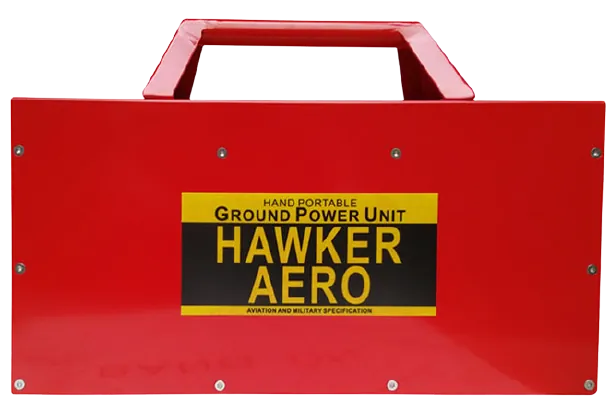
The 2025 Hawker Aero models doubled the starting power with practically the same weight and size: up to 5,500 A peak from 35 kg.
Frequently asked questions
Is a lithium GPU better than a lead-acid one?
For engine starting, usually yes: for the same power a Hawker Aero LFP unit is up to 60% lighter and 30% smaller, lasts twice as long and has no memory effect. Lead-acid units can cost less to buy. Both are starting units, not continuous power sources.
Are lithium GPUs safe?
Hawker Aero GPUs use lithium iron phosphate (LFP), the most thermally stable of the common lithium chemistries, in an aluminium case, and are UN38.3 certified for air transport. As with any battery, follow the charging instructions and never discharge below 25 V.
When is a diesel GPU the better choice?
When you need continuous power for long periods (avionics, air conditioning, maintenance) at a fixed airport ramp where the unit can be towed and refuelled. For starting engines away from the ramp, a portable battery unit is far easier to handle.
Does cold weather affect a lithium GPU?
Hawker Aero units are rated from −30 °C to +60 °C. In very cold conditions any battery delivers less energy, which is when the 180 Ah models or two units in parallel make the difference.
Can I replace my old lead-acid starting unit?
Yes. Tell us your aircraft and how you use your current unit, and we recommend the Hawker Aero model that matches or exceeds it.
Keep reading
Moving to lithium? Ask us
Tell us your aircraft and the unit you use today. We reply in writing with the matching Hawker Aero model and price.
- Written reply within 24–48 h
- Exclusive distributor of Hawker Aero
- Worldwide shipping